
Let me guess how your week has gone. Back pain on Monday. You said, “Arrey, it’s the chair.” Tuesday, a tablet. Wednesday, a hot water bag. By Friday, the pain has quietly moved house, and now it lives in your thigh, sometimes your calf, and it bites whenever you sit. Sound familiar? Then this blog is for you. Read it with a cup of chai; it won’t take long.
Slip disc, but nothing actually slips
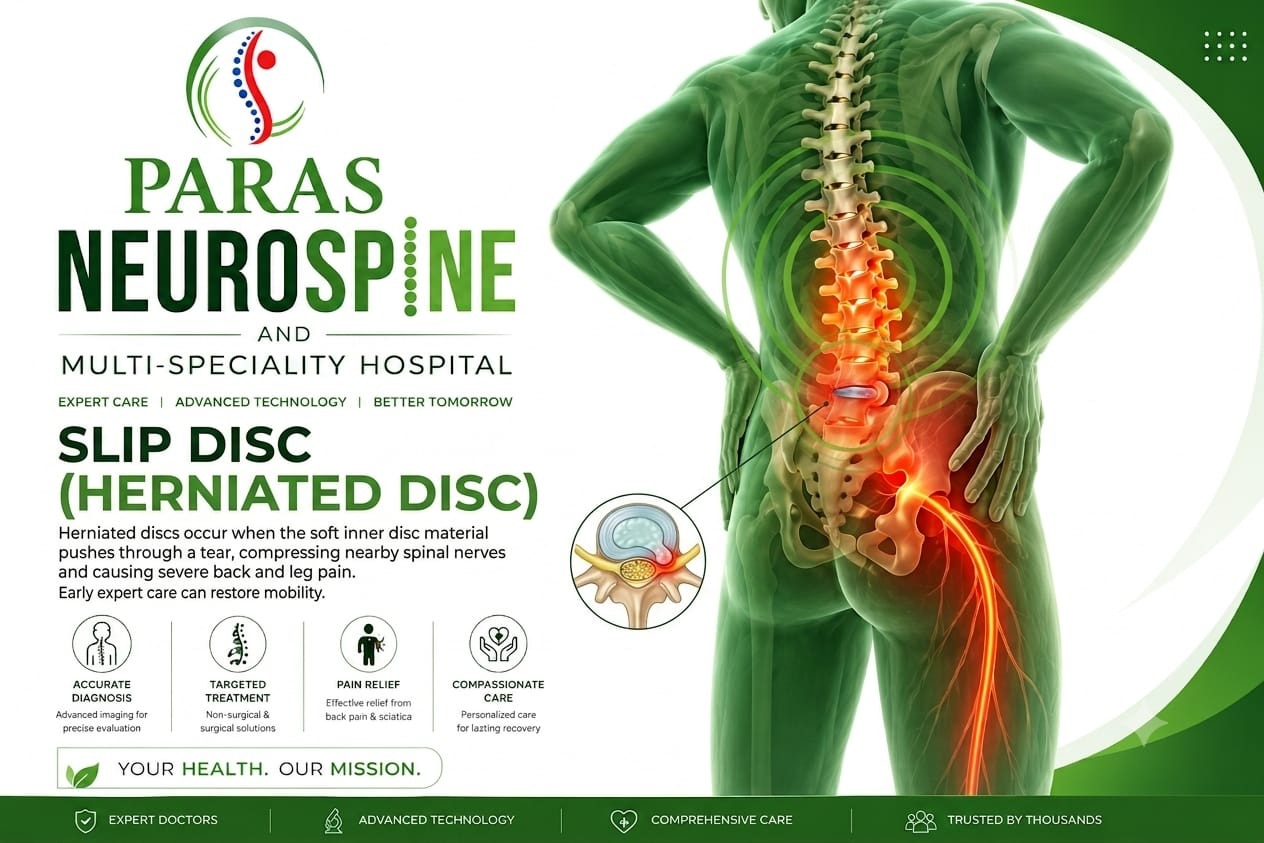
Everyone calls it a slip disc. Doctors say herniated disc. Whatever the name, picture a tube of toothpaste that’s been squeezed a bit too hard. The soft part inside the disc finds a crack in the outer wall and pushes through. That alone doesn’t hurt much. What hurts is when that squeezed-out bit lands on a nerve right beside it, like a foot on a garden hose. The nerve then sends signals down its whole length, which is why you feel it in the leg or arm and not in the spine itself. Confusing, I know.
The signs, in plain words
In the lower back, you’ll feel a shooting or burning pain that goes down one leg—maybe tingling in the toes. Maybe one leg feels weaker, and your foot drags a little on the floor.
In the neck, the pain slips into the shoulder, and the arm, and the fingers go numb or buzzy. Some people suddenly can’t hold a cup properly.
Usually it’s one side only. Sitting, bending, coughing, sneezing- these make it worse.
Why me?
Honestly, it’s rarely one reason. A few things pile up over the years: a desk job and a bent back. Lifting a heavy bucket the wrong way—a few extra kilos. Smoking, which most people don’t connect with the spine, but it does reduce the blood supply to the discs. Add age, since discs get drier and weaker with time, and sometimes a family tendency. We meet patients in their late twenties, so please don’t assume this is an “old person’s problem”.
When should you see someone?
A mild one can settle on its own with rest and ordinary medicines, usually in a week or two. If it hasn’t, go and get it checked. Same if a leg or arm feels weak or numb, if the pain keeps you awake at night, or if even a flight of stairs has become a mountain.
Now the serious bit, so read slowly. Can’t hold your urine or stool? Groin or inner thighs gone numb? That is an emergency, and it can’t wait for your regular doctor’s timing. Go to a hospital the same day. It may be cauda equina syndrome, where the nerves at the bottom end of the spine are being pressed hard, and the damage can turn permanent if treatment is late.
What the doctor will do
Mostly, talk to you. Where is the pain, where does it go, what sets it off? Then they’ll do a quick check of your reflexes, strength, and feeling in your limbs. An MRI usually follows, because it shows the disc and the nerve clearly.
Why bother with all this? Because a lot of back pain isn’t from a disc, and many slipped discs don’t need surgery. The scan and the examination tell you which situation you’re in. Guessing doesn’t.
Do I need surgery?
Often, no. Start with a couple of days of rest (not a month in bed, please), medicines for the pain and swelling, and physiotherapy so the muscles around your spine can take some of the load. Still hurting? An injection close to the nerve sometimes helps. Most people need a few weeks, some a few months.
Surgery comes into the picture when the pain refuses to go, or when weakness and numbness are getting worse. These days many disc problems are fixed through a small cut with fine instruments, which usually means less pain, less blood loss, fewer days in hospital and a quicker return to normal life. A large disc fragment or an unstable spine may need something bigger.
What’s right for you depends on your scan, your symptoms, your job and your age. And a good surgeon will say so honestly when you don’t need an operation at all.
Who will treat you
Dr. Pramod Chaurasia has treated brain, spine, and nerve problems for over 20 years, and he has done more than 6,000 surgeries. That’s a very long time in the operating theatre. He has seen easy discs and difficult ones, and he knows when to operate and when to say “let’s wait.”
His treatment has a 98% success rate. But read his Google reviews and see what patients actually write. They say he listened. They say he explained the MRI in simple words and was frank about whether surgery was really needed. Many of them call him “God.” People don’t say that casually, and he’s earned that trust in Lucknow and far outside it.
Where you’ll be treated
Paras Neurospine and Multi-Speciality Hospital is built around brain, spine and nerve care. Other specialities are there too, so if you also have sugar or a heart problem, nobody sends you running to another hospital halfway through.
The hospital is NABH accredited, which means an independent body has looked at its patient safety and quality of care. It also has the latest equipment for diagnosis and surgery. Consultation, MRI review, surgery, physiotherapy, follow-up: all under one roof. The staff take the time to explain things to you and your family in a language everyone understands, and patients arrive from all over Lucknow and the nearby districts.
Little things that protect your back
Nothing fancy. Bend your knees when you lift. If you sit all day, get up and walk for a couple of minutes every half hour. Keep the screen at eye level, a small cushion behind the lower back. Walk daily, keep your stomach and back muscles strong, don’t let the weight creep up, and if you smoke, now is a good time to quit.
Quick answers
Will it heal without surgery?
Often, yes. The bulge can shrink over a few weeks or months, and many people recover on medicines and physiotherapy alone. If the pain lasts or gets worse, see a specialist.
Is surgery safe?
With an experienced surgeon, modern disc surgery is considered safe and effective.Results depend on the right diagnosis, the surgeon’s skill and good aftercare.
How long to recover?
Varies from person to person. After minimally invasive surgery, many people walk within a day or two and go back to light work in a few weeks. Your surgeon will give you a timeline for your own case.
Should I stop exercising?
Not completely. Too much bed rest slows recovery, and gentle movement is usually encouraged. Heavy lifting and hard workouts can wait until your doctor says okay.
Don’t just carry on
If your back pain is travelling into the leg or arm, or you’re feeling numbness or weakness, please don’t brush it off. An early visit to a specialist can stop a small problem from turning into a big one. Book a consultation with Dr. Pramod Chaurasia at Paras Neurospine and Multi-Speciality Hospital, Lucknow.
Call 9467820334