
A brain hemorrhage doesn’t knock politely. One moment a person is chatting over tea, the next they’re clutching their head, slurring words, or unable to lift an arm. Families often lose precious minutes wondering if it’s “just a bad headache” or tiredness.
Those minutes matter. In a brain bleed, blood leaks into or around the brain, and the surrounding tissue starts getting damaged almost immediately. The faster the person reaches a hospital with a proper neurosurgery team, the better the chance of recovery. This guide explains what to watch for, what causes it, and how treatment works.
What exactly is a brain hemorrhage?
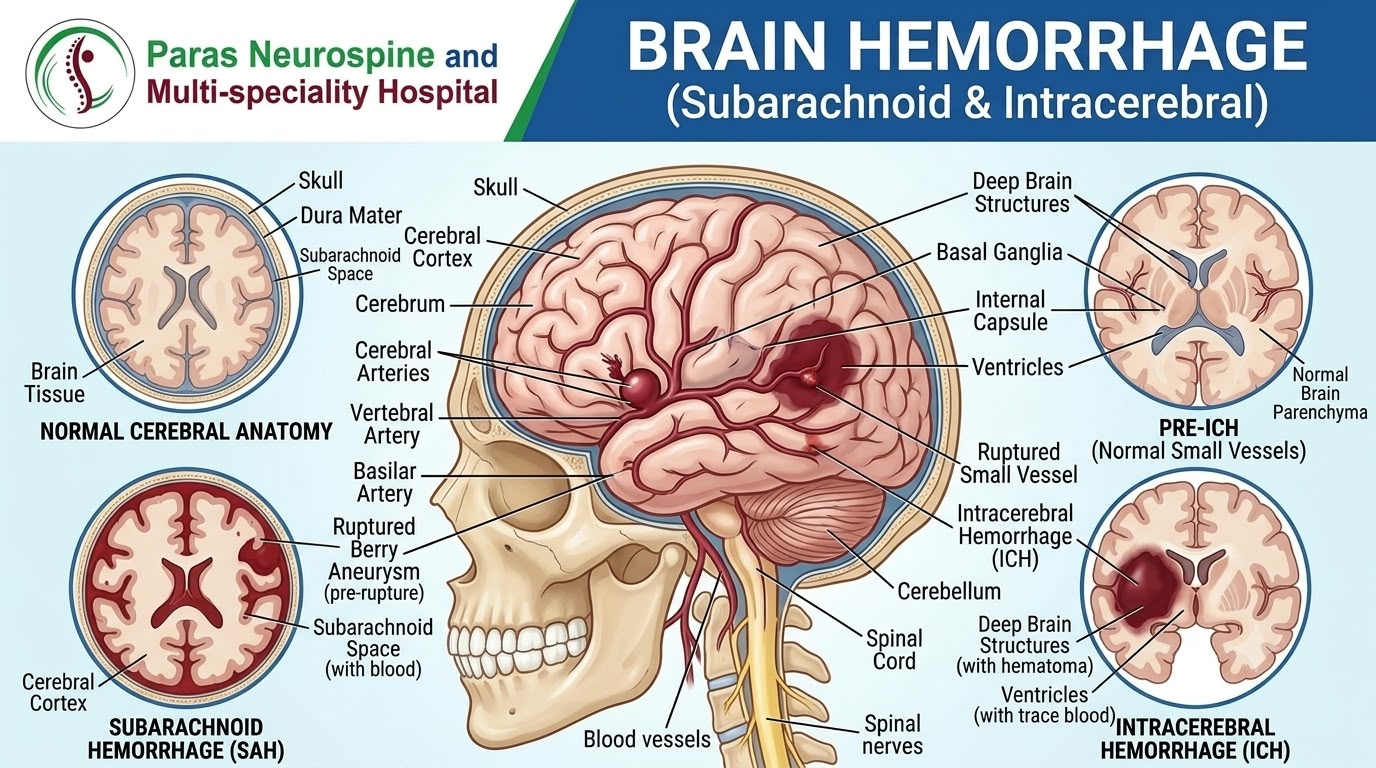
A brain hemorrhage (also called intracranial hemorrhage or a brain bleed) happens when a blood vessel inside the skull ruptures. The leaked blood builds pressure on the brain and also deprives nearby cells of oxygen. It’s a type of stroke, the “hemorrhagic” kind, and it is always a medical emergency.
Doctors usually group brain bleeds by where the blood collects:
- Intracerebral hemorrhage: bleeding inside the brain tissue itself, most often linked to high blood pressure.
- Subarachnoid hemorrhage: bleeding in the space around the brain, commonly from a burst aneurysm.
- Subdural and epidural hematoma: blood collecting between the skull and brain, usually after a head injury.
- Intraventricular hemorrhage: bleeding into the fluid-filled chambers of the brain.
Emergency signs you should never ignore
Symptoms usually appear suddenly. Watch for:
- A sudden, explosive headache, often described as the worst headache of one’s life
- Weakness, numbness or drooping on one side of the face or body
- Slurred speech or trouble understanding what others say
- Vomiting, especially along with a severe headache
- Confusion, extreme drowsiness or sudden loss of consciousness
- Blurred or double vision, or loss of balance
- Seizures in someone who has never had one
- A stiff neck with sensitivity to light
Don’t wait to see if it passes. If you notice any of these, take the person to a hospital with neurosurgical care straight away. Don’t give food, water or home remedies, and don’t let them drive themselves.
What causes a brain bleed?
The single biggest culprit in India is uncontrolled high blood pressure. Years of pressure weaken small vessels until one gives way. Other common causes include:
- Head injuries from road accidents or falls
- Aneurysms (weak, bulging spots on an artery) and arteriovenous malformations (AVMs)
- Blood-thinning medicines, or bleeding and clotting disorders
- Brain tumors that bleed
- Smoking, heavy alcohol use and diabetes, which damage blood vessels over time
How doctors diagnose it
Speed is everything here, so diagnosis is quick. A CT scan of the head is usually the first test, since it shows fresh blood clearly within minutes. Depending on the case, the team may add an MRI, or a CT/DSA angiogram to find an aneurysm or abnormal vessel. Blood tests check clotting and overall health.
Treatment: when is surgery needed?
Not every brain bleed needs an operation. A small bleed in a stable patient may be managed with intensive monitoring, blood pressure control and medicines to reduce brain swelling. Surgery is considered when the bleed is large, pressure inside the skull is climbing, or the patient’s condition is getting worse.
Common surgical options include:
- Craniotomy and clot removal: a part of the skull is opened temporarily so the surgeon can remove the blood clot and relieve pressure.
- Decompressive craniectomy: a section of skull is removed to give a swollen brain room, and replaced later.
- Aneurysm clipping or coiling: the weak vessel is sealed off so it can’t bleed again.
- Burr-hole drainage: a small opening used to drain certain chronic subdural collections.
- Minimally invasive clot evacuation: in selected patients, smaller incisions and precise techniques reduce damage to healthy tissue.
Which option is right depends on the size and location of the bleed, the patient’s age and neurological state, and the cause. That judgement call is exactly why an experienced neurosurgeon matters.
Recovery after a brain hemorrhage
Recovery is different for everyone. Some people regain strength within weeks; others need months of rehabilitation. Physiotherapy helps with movement and balance, speech therapy helps with communication, and occupational therapy helps people get back to daily routines. Controlling blood pressure, taking medicines on time, quitting tobacco and regular follow-ups lower the risk of another bleed.
Patience matters. Small gains, like holding a cup or taking a few steps, are real progress and worth celebrating.
Brain hemorrhage treatment in Lucknow: why families choose Paras Neurospine
Brain hemorrhage treatment in Lucknow needs a team that can act in minutes, not hours. At Paras Neurospine and Multi-Speciality Hospital on Raebareli Road, patients are treated by a dedicated neurosurgical team led by Dr. Pramod Chaurasia, a senior neurosurgeon with over 20 years of experience and more than 6,000 surgeries behind him.
The hospital is NABH accredited and equipped with modern diagnostic and surgical facilities, so scanning, decision-making and surgery (when needed) happen under one roof. Dr. Chaurasia is known for a clear, honest approach: he explains what’s happening, what the options are, and what the family can realistically expect. Many patients and relatives describe him in their Google reviews as nothing short of God, which says a lot about the trust built over the years.
If you’re looking for a brain hemorrhage surgeon in Lucknow, or a neurosurgeon you can trust with a family member’s life, Paras Neurospine is ready to help.
Frequently asked questions
Can a person survive a brain hemorrhage?
Yes. Survival and recovery depend on the size and location of the bleed and how quickly treatment begins. Early hospital care makes a big difference.
Is a brain hemorrhage the same as a stroke?
It’s one type of stroke. Strokes are either caused by a blocked vessel (ischemic) or a burst vessel (hemorrhagic). A brain hemorrhage is the hemorrhagic kind.
Does every brain hemorrhage need surgery?
No. Smaller bleeds can often be managed with medicines and close monitoring. Surgery is advised when the bleed is large or pressure on the brain is rising.
Can it be prevented?
Often, yes. Keeping blood pressure under control, avoiding smoking and excess alcohol, managing diabetes, and wearing helmets and seatbelts reduce the risk significantly.
Need urgent neurosurgical help?
Paras Neurospine and Multi-Speciality Hospital, Raebareli Road, Lucknow
Call: +91 8957051954 | +91 9467820334