
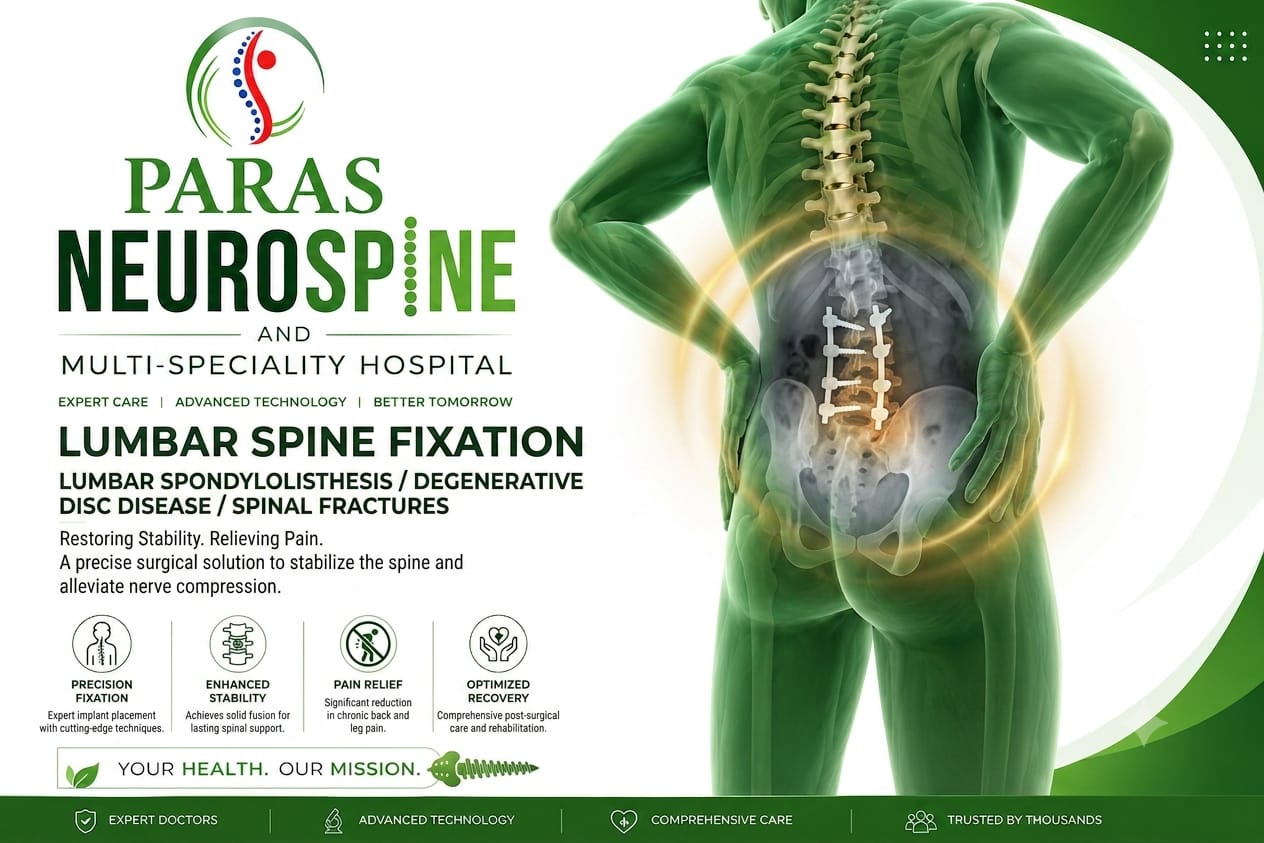
A doctor informs a patient of the need for a ‘spine fixation’ but the latter has a series of questions before surgery day arrives. Are screws or a plate used? Is there a cage, and if so, would the disc be removed? In fact, these are questions that arise almost daily at Paras Neurospine and Multi-Speciality Hospital, Lucknow, prompting the idea to compile a series of answers.
Dr. Pramod Chaurasia, who has been performing spine fixation surgeries in the region for over 20 years, has already performed over 6500 surgeries, most of which are detailed below:
Spine Fixation Explained
Surgery to stabilize an unstable section of the spine, such as a vertebral segment. This can include the use of screws, rods, plates, and cages during surgery depending on the nature and location of the problem. The hardware is used to hold the repair area of the spine immobile for a period of time while the vertebrae heal.
One thing that many patients are not aware of when it comes to spine fixation surgery is the fact that the hardware used is not the fix, although it is needed to provide the initial fix. The actual healing is the fusion that occurs between the vertebrae in the area of repair, and this requires the patient to retain the hardware for approximately 6 months. The removal of the hardware at too early a stage will compromise the fusion.
Spine fixation surgery does not refer to one specific surgery but a whole category of surgeries. Within this category, the approach and techniques can vary depending on a number of factors such as which vertebrae are being operated on, the nature of the damage or degenerations, and the patient’s bone density. It is possible to know approximately which surgery would be performed with a view to addressing the patient’s condition and after reviewing an MRI.
Candidates
Before turning to spine fixation surgery, candidates will most likely have gone through conservative treatment options (physiotherapy, medication, even injections) for a period of several weeks or months. Candidates will most often have one or more of the following conditions:
Degenerative disc disease to the point of chronic pain due to loss of function
Vertebral fracture (most often due to an accident)
Spondylolisthesis (forward slippage of one vertebrate over another)
Scoliosis or other deformity (which may be progressive)
Spine instability due to tumors or infection
Spinal stenosis (narrowing) compressing a nerve, leading to paresis
If two or three of the above issues apply to you and conservative treatment options have proven ineffective, it is possible to turn to specialized surgery for an opinion and potentially go ahead with spine fixation surgery.
Approaches
There is more than one approach to spine fixation surgery. The techniques and hardware used vary depending on such factors as the patient’s condition, the vertebrae that need to be operated on and the patient’s bone density. Some of the major forms of spine fixation surgery include:
Fixation using pedicle screws and a connecting rod. Screws are placed on each side of the vertebrae and a rod is placed at the top, connecting these screws. The vertebrae are then held stable while the fusion progresses.
Interbody fusion – a disc is inserted between adjacent vertebrae, which can help restore disc height and promote fusion.
Plating – a metal plate is used to fasten the vertebrae together using screws.
Minimally invasive spine fixation – this refers to a number of techniques that use smaller incisions and/or image guidance to place the hardware. This form of surgery is not possible in every case, but it can lead to a quicker return to activity. This approach is available at Paras Neurospine and Multi-Speciality Hospital in suitable cases.
The type of surgery Dr. Chaurasia will recommend to you depends on your MRI, bone density, age, and occasionally which approach has proven to have better results for similar cases.
Spine Fixation Surgery – Procedure
The surgical procedure is broken down into roughly three stages:
Access – the area that needs to be operated on is accessed, and any damaged disc or tissue is removed. Fixation takes place and the surgical site is then closed.
Depending on the extent of the surgery (how many vertebrae are impacted), the length of time spent on the operating table can vary considerably. A single level procedure can take a couple of hours, whereas the reconstruction of multiple levels can take much longer.
Recovery – The general length of a hospital stay following spine fixation surgery is between three and five days. Patients will receive post-operative analgesics and be encouraged to get up and walk while being monitored. After discharge, patients are often recommended to take it easy for up to six weeks following the surgery with the use of a brace in some cases, and to gradually progress their activities. Physiotherapy typically starts after about two weeks as waiting too long can hinder the rehabilitation process.
The process of bone fusion takes months and most people report feeling relatively normal between six and twelve months after the surgery, depending on how much was done during the operation. Your team at Paras Neurospine and Multi-Speciality Hospital will continue to follow up with you throughout the recovery and rehabilitation process.
Spine Fixation Surgery – Risks
As with all types of surgical intervention, spine fixation surgery carries risks such as infection, hemorrhage, nerve root irritation, and hardware failure. Failure of the fusion is possible (non-union), which may require a further operation. There are also some individual risk factors such as smoking and diabetes which can increase the risk of complications, and it is beneficial to disclose any such risk factors to your surgeon.
Ask your surgeon about the chances of requiring a further operation should your fusion not be successful, as well as the likelihood of complications in your particular case. Any evasiveness on the part of a surgeon when you ask about these matters tends to be a warning sign.
Frequently Asked Questions
- What is spine fixation surgery?
Spine fixation surgery refers to a number of techniques that can be used to stabilize a section of the spine that has proven unstable. This can require the use of various different types of hardware including screws, rods, plates and cages.
- Is spine fixation surgery painful?
Like all surgeries, fixation surgery involves pain following the operation, but this is controlled using post-operative analgesics, which are administered while you are in hospital. The pain will dissipate steadily throughout the first few weeks. It should be noted that pain is a normal part of the recovery process, but it should steadily decrease.
- How long does it take to recover from spine fixation surgery?
Patients are able to resume light activity after four to six weeks following the surgery. It should be noted, however, that full function and fusion takes much longer, generally speaking between six and twelve months, depending on the extent of the surgery.
- Is spine fixation surgery the same as spinal fusion?
Spine fixation surgery refers to the initial stabilization of the spine using hardware such as screws, rods, plates and cages. This is a different procedure from spinal fusion, although the two procedures can be combined during a single operation. Spinal fusion refers to the biological process by which the spine is allowed to fuse together, and this process is greatly assisted by fixation surgery.
- Am I a candidate for spine fixation surgery?
If conservative treatments have proven ineffective, and you are suffering from instability in the spine, vertebral fracture, degenerative disc disease, spondylolisthesis or nerve compression, it is possible that you would be a candidate for spine fixation surgery. Dr. Chaurasia at Paras Neurospine and Multi-Speciality Hospital will evaluate your case to determine whether this type of surgery is suitable for you.
- Where can I go for spine fixation surgery in Lucknow?
Spine fixation surgery can be performed at Paras Neurospine and Multi-Speciality Hospital in Lucknow, which is overseen by Dr. Pramod Chaurasia and offers minimally invasive spine fixation surgery in appropriate cases.
- How do I book an appointment for spine fixation surgery?
You can book an appointment to discuss spine fixation surgery by calling 9467820334 or by visiting parasneurospine.in.
Why Patients Choose Paras Neurospine
With more than 20 years’ experience and more than 6500 successful spine fixation surgeries performed to date, Paras Neurospine and Multi-Speciality Hospital boasts considerable expertise in the field of spine fixation surgery. However, this extensive expertise translates into small things, such as how quickly a potential complication can be dealt with, or how quickly a case can be read on a scan. Beyond the experience and success of Dr. Pramod Chaurasia himself, the patients who visit Paras Neurospine and Multi-Speciality Hospital for spine fixation surgery benefit from:
A tailored approach based on an analysis of your MRI and medical history rather than a generic approach based on experience alone.
Access to cutting–edge spine fixation surgical techniques, including minimally invasive spine fixation surgery, where appropriate.
A single point of contact throughout the entire process, from diagnosis to post-operative rehabilitation.
A person to contact if you have questions or concerns regarding your spine fixation surgery at any point following your surgery.
About Dr. Pramod Chaurasia
With more than 20 years of experience and more than 6500 successful spine fixation surgeries to his credit, Dr. Pramod Chaurasia of Paras Neurospine and Multi-Speciality Hospital takes a personal interest in each and every one of his patient‘s cases, tailoring each treatment to their individual needs. This includes continuing to follow-up with his patients following spine fixation surgery. This level of dedication is the reason that patients from all over the region continue to choose Dr. Chaurasia for his spine fixation expertise.
Get in Touch
Chronic back pain often creeps up on people. Life adapts around it and before long an entire lifestyle has been altered without people realising what has happened. If you are considering spine fixation surgery for back pain, it is essential to be informed.
Call 9467820334 to book a consultation with Dr. Pramod Chaurasia, or visit parasneurospine.in to learn more about spine fixation surgery at Paras Neurospine and Multi-Speciality Hospital.