
Most people picture a stroke as something loud and obvious. Someone collapses, everyone panics, the ambulance is called. Real life is quieter than that. Think of a 60-year-old man at the breakfast table. His tea cup slips. His wife laughs it off, but then she notices his words are coming out mushy. He says he’s fine, just tired. Two hours later he’s in a hospital corridor, and the doctors are asking one question: when did this start? That question decides a lot. In neurosurgery we say “time is brain,” and we mean it literally. While a stroke is going on, brain cells die by the millions every minute. Nothing grows back on its own. So here’s the good part. You don’t need a medical degree to catch a stroke early. You need to remember four letters.
FAST: the check that takes ten seconds
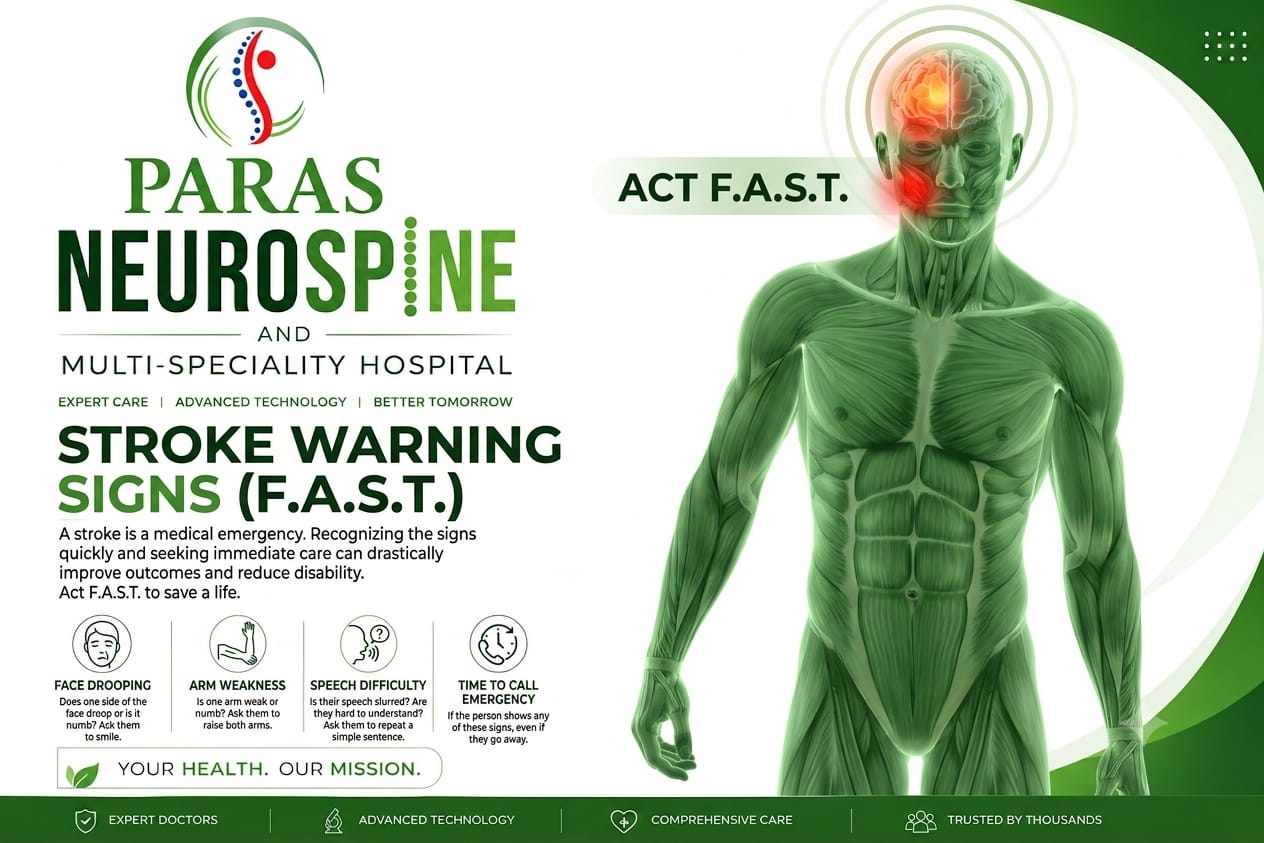
F is for face. Ask the person to smile. If one corner droops or the smile looks lopsided, that’s a flag.
A is for arms. Have them lift both arms in front of them. Does one sink, or refuse to go up at all?
S is for speech. Ask them to repeat something simple, like “the sky is blue in Lucknow.” Slurred, jumbled or strangely slow words count. So does not understanding what you just said.
T is for time. One sign is enough. Call for help now and look at the clock. Write down when it began, or at least when you last saw the person normal. The hospital team will lean on that number.
Signs that don’t fit the FAST box
Not every stroke shows up on the face. Some hit balance or eyesight first. Watch for a sudden spinningdizziness, a stumble for no reason, vision that goes double or blurry, or a headache so fierce it feels like the worst of your life. Sudden confusion counts too, and so does numbness down one side.
One rule covers all of it: if it came on suddenly and it involves the face, limbs, speech, sight or balance, treat it as an emergency until a doctor says otherwise.
When the symptoms disappear
This one trips people up. Sometimes the drooping face or weak hand clears up in ten minutes, and everyone relaxes. Please don’t. That can be a transient ischemic attack, or TIA, a mini-stroke where the blockage clears by itself. No damage stays behind, but the danger isn’t over. It’s often the body’s only warning before a bigger stroke. Go to the hospital the same day.
While you wait for the ambulance
Call 112. Sit the person somewhere comfortable with their head supported, and stay with them. Grab their medicine strip or prescription if it’s nearby, because the doctors will want it.
Skip the water, the tablets and the home remedies. Swallowing can be affected during a stroke, and a sip meant to help can end up in the lungs. And if an ambulance can reach you quickly, let it. Driving a stroke patient through traffic while panicking rarely saves time.
Why the hospital you pick matters
A stroke is either a blockage or a bleed, and treatment for one can be harmful for the other. That’s why a fast, accurate scan and an experienced eye on the result matter so much. When it’s a brain bleed, the pressure inside the skull may need a neurosurgeon’s attention quickly.
This is the kind of work we do at Paras Neurospine and Multi-Speciality Hospital in Lucknow. We’re a dedicated brain and spine center, NABH accredited, and equipped with the latest technology for diagnosis. The neurosurgical team is led by Dr. Pramod Chaurasia, who has more than 20 years of experience and over 6,000 surgeries behind him. His reported success rate is around 98%, though every patient’s outcome depends on their condition and overall health.
Ask families who’ve come through his care and a pattern shows up in their reviews. He listens. He explains what’s happening without hiding behind jargon. On the worst day of a family’s life, that matters almost as much as the surgery.
Who should be paying closer attention?
Blood pressure is the big one. Uncontrolled hypertension quietly damages arteries for years. Diabetes, high cholesterol, smoking, heavy drinking, an irregular heartbeat and a family history all raise the odds. Age past 55 counts as well, but we’re seeing more strokes in people in their thirties and forties than we used to.
If several of those apply to you, don’t wait for a scare. Get your pressure checked regularly, take the medicines you’ve been prescribed, cut back on salt and tobacco, and walk for half an hour most days. Nothing dramatic, just consistent.
Quick answers
What does FAST stand for?
Face drooping, Arm weakness, Speech trouble, Time to call for help.
Quick answers What does FAST stand for?
Face drooping, Arm weakness, Speech trouble, Time to call for help.
How soon should a stroke patient reach a hospital?
As fast as possible. The first few hours give doctors the most options.
Can strokes be prevented?
Many can, mainly by keeping blood pressure, sugar and cholesterol in check and staying away from tobacco.
Who is the best neurosurgeon for brain and spine care in Lucknow?
You want experience, accredited standards and honest advice. Dr. Pramod Chaurasia at Paras Neurospine and Multi-Speciality Hospital offers all three.
One last thing
If something feels off with you or someone near you, don’t talk yourself out of it. Being wrong and going in is a small inconvenience. Being right and waiting can change a life. To speak with a specialist about your brain, spine or nerve health, book a consultation with Dr. Pramod Chaurasia at Paras Neurospine and MultiSpeciality Hospital, Lucknow.
This article is for general awareness and doesn’t replace medical advice. In an emergency, call 112 immediately