
Some people tell us the same thing in the consulting room. “I can walk to the end of the lane, and then my legs just give up. I sit down for a minute, and I’m fine again.” If that sounds familiar, the problem may not be your legs at all. It may be your spine.
This is the classic story of lumbar spinal stenosis, a condition that quietly affects many people after the age of 50. Here’s what it is, how to recognise it, and what can actually be done about it.
What is lumbar spinal stenosis?
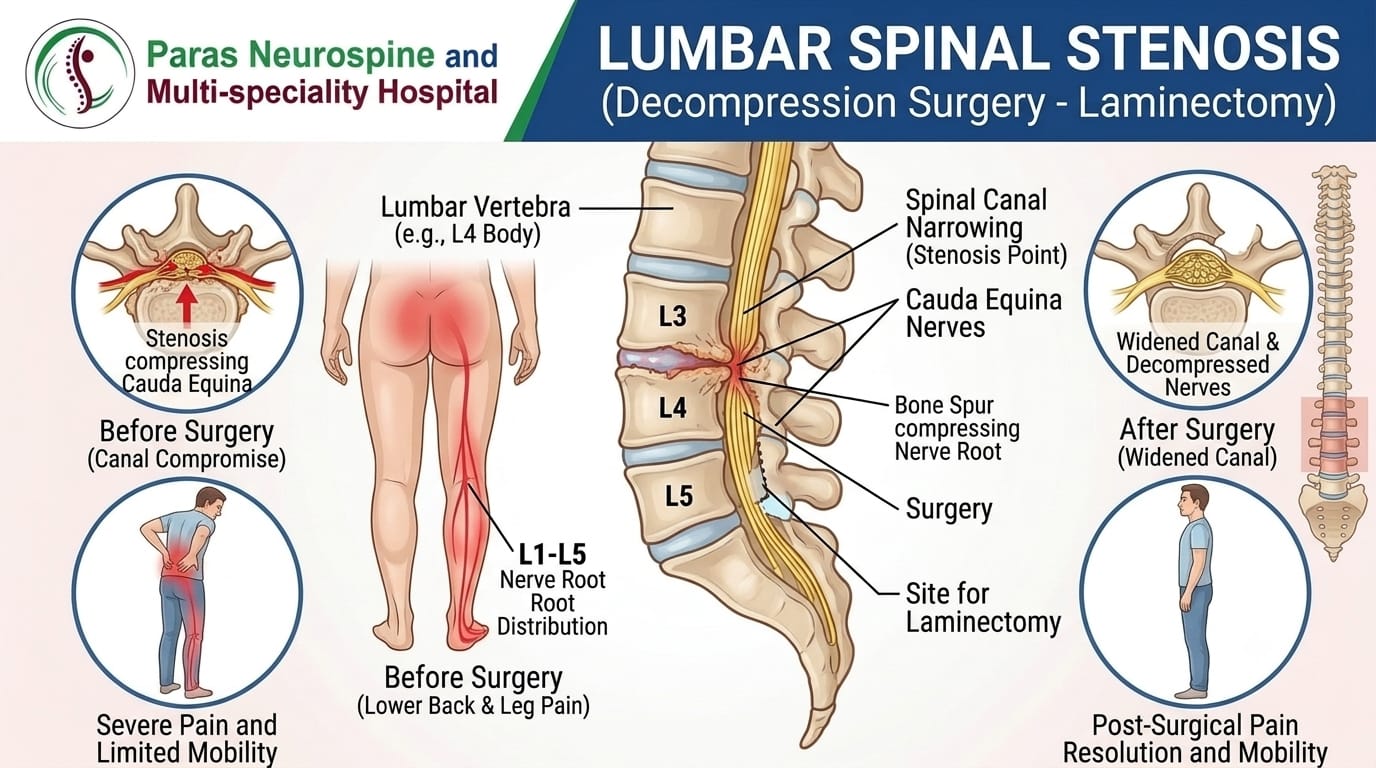
Your spinal canal is a narrow tunnel that carries the spinal cord and nerves down your back. Over the years, discs thin out, joints thicken, and ligaments become stiff. The tunnel slowly gets tighter, and the nerves inside get squeezed. Doctors call this narrowing stenosis. When it happens in the lower back, it’s lumbar spinal stenosis.
It isn’t an injury, and it doesn’t appear overnight. For most people it’s wear and tear that builds up over a decade or more. Less often, it’s something a person is born with, or it follows an old fracture or a slipped disc.
Symptoms people often ignore
The tricky part is that symptoms come and go, so many patients wait months or even years before seeing a specialist. Watch for these:
- Pain, heaviness, or cramping in one or both legs when you walk or stand
- Relief when you sit down, bend forward, or lean on a shopping cart
- Numbness, tingling, or a “pins and needles” feeling in the buttocks, thighs, or feet
- Weakness in a leg, or a foot that tends to catch or drag
- Lower back ache that settles once you rest
That forward-leaning relief is a useful clue. Bending forward opens the spinal canal a little, which is why people with stenosis often feel better walking uphill or pushing a trolley than walking on flat ground.
Please don’t wait if you notice loss of bladder or bowel control, numbness in the groin area, or sudden severe weakness in the legs. These are emergency signs. Get to a hospital the same day.
How is it diagnosed?
A careful conversation and physical examination come first. A good spine surgeon will ask how far you can walk, what eases the pain, and whether your balance has changed. An MRI of the lumbar spine then shows exactly where the canal is narrowed and how many levels are involved. In some cases, X-rays or a CT scan are added to look at bone structure and spinal alignment.
One important point: the MRI report alone doesn’t decide your treatment. Plenty of people have a narrowed canal on a scan and very few symptoms. What matters is how the scan matches your complaints.
Treatment: surgery is not the first step for everyone
This is something we want patients to hear clearly. Many people with mild to moderate stenosis improve without an operation.
- Medication to calm nerve irritation and inflammation, as prescribed by your doctor
- Physiotherapy focused on core strength, posture, and flexibility
- Epidural steroid injections to reduce swelling around the compressed nerves, for temporary relief
- Activity changes, such as walking in shorter intervals, using a cycle for exercise, and managing body weight
These measures help many patients stay active and comfortable for a long time. Give them an honest trial, usually a few months, unless your symptoms are getting worse quickly.
When does surgery make sense?
Surgery is worth discussing when:
- Pain or numbness keeps limiting your daily life despite proper non-surgical treatment
- You can only walk a short distance before you have to stop
- Leg weakness is increasing, or balance is becoming unsteady
- There are any bladder or bowel changes
The most common operation is a lumbar decompression, often called a laminectomy or laminotomy. The surgeon removes the small amount of bone and thickened tissue pressing on the nerves, giving them room again. When the spine is also unstable or slipped, decompression may be combined with spinal fusion to hold the segment steady. Where suitable, minimally invasive techniques allow this through smaller incisions, which can mean less pain and a quicker return to walking.
The right procedure depends on your scan, your symptoms, and your overall health. It should be explained to you plainly, with the pros and cons, before any decision is made.
Recovery: what to expect
Most patients are encouraged to start walking within a day or so of surgery. Leg pain often eases early, while numbness can take weeks or months to fade because nerves heal slowly. You’ll be guided on safe movement, wound care, and a graded exercise routine. Heavy lifting and long hours of sitting are usually avoided for a while. Following the physiotherapy plan makes a real difference to the final result.
Treating spinal stenosis in Lucknow at Paras Neurospine
If you’re looking for spinal stenosis treatment in Lucknow, you want a surgeon who will first tell you whether you need surgery at all, and then do it well if you do. Dr. Pramod Chaurasia at Paras Neurospine and Multi-Speciality Hospital has more than 20 years of experience and has performed over 6,000 surgeries, with a 98% success rate. The hospital is NABH accredited and equipped with the latest technology for spine and brain care.
Many patients tell us they came in scared of surgery and left relieved that someone finally explained their options without pressure. That’s how a consultation should feel.
Frequently asked questions
Can spinal stenosis go away on its own?
The narrowing itself doesn’t reverse, but symptoms can settle with exercise, medication, and lifestyle changes. Many people manage well without surgery.
Is walking good for spinal stenosis?
Yes, in moderation. Short walks, cycling, or swimming are usually better tolerated than long walks on flat ground. Rest when needed.
Is spinal stenosis surgery safe?
For the right patient, in experienced hands, it’s a well-established operation. Your surgeon should explain the specific risks for you.
How long does recovery take?
Most people walk soon after surgery and return to light daily activity within a few weeks. Full recovery varies with age, the number of levels treated, and how long the nerves were compressed.
Which doctor should I see for spinal stenosis?
A neurosurgeon or spine surgeon. In Lucknow, you can consult Dr. Pramod Chaurasia at Paras Neurospine and Multi-Speciality Hospital.
Book a consultation
If leg pain, numbness, or heaviness is cutting your walks short, don’t write it off as age. A proper evaluation can tell you whether simple measures will do or whether it’s time to consider surgery. Contact Paras Neurospine and Multi-Speciality Hospital, Lucknow, to book an appointment with Dr. Pramod Chaurasia.